Forum for Research on Phenomenon-Oriented Science (FoRPhOS)
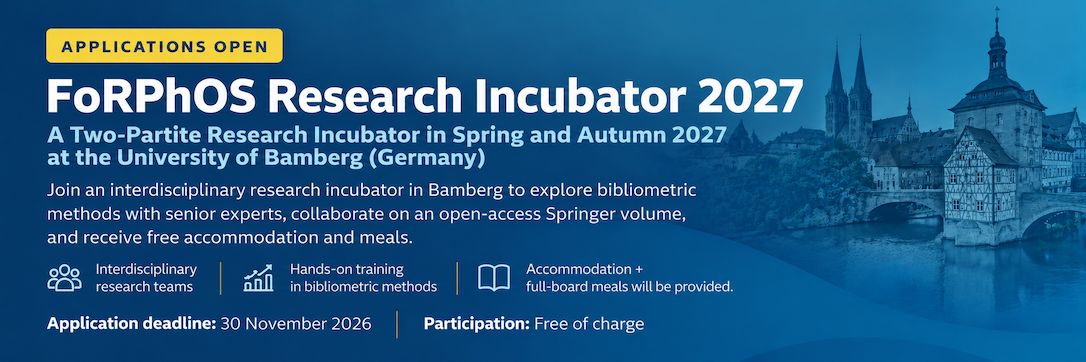
FoRPhOS is a research incubator for early-career researchers from the interdisciplinary phenomenon-oriented fields of Transformation Studies, Migration Research, Terrorism Research, Inequality Studies and Political Epistemology (details below), who are interested in studying the evolution of their field. At the same time, they will develop skills in bibliometric analysis.
You will team up with peers from your field but with diverse disciplines of origin and a senior expert from that field. You will complement your topical expertise by learning new bibliometric tools, such as corpus delineation, data cleaning, citation and collaboration network analysis, natural language processing, topic modelling, and the calculation of field-specific impact metrics. No prior experience with these methods (or any advanced quantitative ones) is required: You will learn all that you need to know at FoRPhOS.
FoRPhOS is output-driven: You will work on a manuscript analysing your research field, comparing disciplinary approaches, identifying research fronts. Results will be published in an open-access edited volume with Springer. Yet, the two blocks in Bamberg will not be only about work but allow building and strengthening your interdisciplinary networks in and beyond your field.
FoRPhOS is free of charge. Accommodation + full-board meals will be provided.
Programme
Seeding Block (in Bamberg, 28 February – 05 March 2027): Project groups review key theoretical work in their phenomenon-oriented field, and receive intensive methodological training in corpus delineation, database management, data cleaning, network analysis, and knowledge visualisation.
Growth Phase (remote, March – August 2027): Groups continue their analyses and draft the papers.
Harvesting Block (in Bamberg, 13 – 17 September 2027): Project groups present draft papers, engage in cross-group discussions, refine manuscripts, and reflect on overarching insights about phenomenon-oriented research. A stakeholder panel provides feedback on findings and practical utility.
Eligibility and Application – Deadline: 30 November 2026
Please fill-in the application form here, providing your motivation and key milestones in your CV.
If you do not have a Google account, please e-mail your application to forphos.ls-kowi@uni-bamberg.de.
We encourage especially submissions by members of structurally marginalised groups in global academia, including people with disabilities, people of colour, FINTA+, and first-generation academics.
Please note: Due to funding restrictions, FoRPhOS is aimed predominantly at participants affiliated with German research institutions. If you are unsure whether you meet these criteria, do not hesitate to send us an e-mail (forphos.ls-kowi@uni-bamberg.de).
Fields studied at FoRPhOS and their topic experts
Transformation Studies
with Ilka Roose, Hochschule für nachhaltige Entwicklung Eberswalde
Transformation Studies examines how societies, organizations, technologies, and individuals undergo significant change guided by and/or in response to technological advancements or environmental or social challenges. It explores the causes, processes, impacts, and challenges of transformation, often combining perspectives from social sciences, economics, sustainability, culture, and innovation to understand and guide complex transitions.
Ilka Roose is a political scientist and research associate at the Research Centre for Sustainability, Transformation and Transfer at the Eberswalde University for Sustainable Development (HNEE). Her research examines the role of higher education institutions in sustainability transformations, with a particular focus on transdisciplinary collaboration, knowledge transfer, and the institutional conditions that enable universities to create societal impact. Her further expertise lies in water management, social innovation and urban sociology.
Migration Research
with Petra Bendel, FAU Erlangen-Nuremberg
and Liane Rothenberger, University of Bamberg
Migration Studies cover a broad field of research on all phenomena associated with internal displacement or (forced) border-crossing movements. Theories, concepts and empirical research refer to different stages and contexts of migration processes, e.g. drivers, political landscapes, (un)welcoming cultures, ethnographic backgrounds, conflicts, and much more.
Petra Bendel is Professor of Political Science at the Institute of Political Science at FAU Erlangen-Nuremberg and is the head of the Research on Migration, Flight and Integration (MFI). She is a founding member of the Center for Human Rights (CHREN) Erlangen-Nuremberg, FAU Erlangen-Nuremberg, Germany, where she leads a variety of research projects as well as practice-oriented pilot projects on migration-related topics. She also transfers her research topics into her university teaching in various Master’s and Bachelor’s degree programs, where she further ensures a practice-oriented exchange with politicians.
Terrorism Research
with Jannis Jost, Kiel University
Terrorism Research examines the causes, development, forms, and consequences of terrorism as an expression of political violence. It examines attacks of lone wolves and terrorist groups as well as patterns that hold across place and time. To do so, the field draws on political science, sociology, psychology, history, and security studies to explore radicalization, extremist ideologies, terrorist organizations, recruitment, counterterrorism, prevention, and the wider social, political, and international effects of terrorism.
Jannis Jost is Department Manager at the Center for Research on Terrorism and Radicalization, Institute for Security Policy in Kiel. He is an experienced terrorism scholar whose expertise is in high demand both within and beyond academia. He has edited multiple handbooks on terrorism research, and hence possesses intimate knowledge of the field, and the contributions made to it by different disciplines. He served twice as project manager for externally funded research projects on online monitoring of extremism and radicalization.
Inequality Studies
with Jan Schulz-Gebhard, University of Bamberg
additional input by Lucinda Platt, London School of Economics
Inequality Studies investigates different forms of social and economic inequalities, ranging from income and wealth via phenomena like pretty privilege to access to health care. It investigates causes as well as consequences of these inequalities and studies potential feedback loops involved. The disciplines contributing to the filed are as diverse as the inequality dimensions studied.
Jan Schulz-Gebhard is a research associate at the Chair of International Economics at the University of Bamberg. His research focuses on aggregation, granularity, and wealth dynamics, examining how differences and interactions between economic agents shape aggregate outcomes. With a background in philosophy and economics, he combines research interests in economic inequality with ones in the history of economic thought, and social choice theory.
Political Epistemology
with Simon Scheller, University of Bamberg
additional input by Rainer Hegselmann, University of Bayreuth
Political epistemology is an emerging interdisciplinary field at the intersection of epistemology, political philosophy, and related social sciences. It investigates how knowledge, belief, truth, expertise, trust, ignorance, and disagreement shape political life—and how political institutions and power relations, in turn, structure epistemic practices, capacities, and inequalities across contemporary societies.
Simon Scheller is managing director of the Institute for Political Science at the University of Bamberg. He has started his research to Political Epistemology in 2014 and led several projects since, which makes him one of the early scholars in the field. Specifically, he investigates the tension between truth and identity in statements about (apparent) facts, as well as the role of populism and disinformation in the potential erosion of trust.
Methods experts and organisers at FoRPhOS
Karin Boczek
Karin Boczek is Junior Professor of Digital Journalism at the Catholic University of Eichstätt-Ingolstadt. Her research focuses on digital journalism, innovation, social media, diversity, and computational communication science. Her award-winning work examines the platformization of news, gender diversity in communication research, and changing journalistic practices.
Maximilian Noichl
Max Noichl is a researcher at Utrecht University, working at the intersection of philosophy, computational social science, and the digital humanities. Using data-mining and AI-methods, he’s researching how scientific concepts and models travel across disciplines, how scientists and philosopher adopt theories and come up with new ideas, and how AI systems can help us do better science and philosophy.
Paul Balluff
Paul Balluff is a computational communication researcher at GESIS. He is specialized in computer assisted content analysis of text and image data. His publications have a thematic focus on political communication in digital spheres.
Muhammad Qasim Pasta
Muhammad Qasim Pasta is an Associate Professor of Computer Science at Habib University, Pakistan. His research bridges network science, data science, and computational social science to study complex systems and patterns of knowledge production. His work focuses on extracting, constructing networks from diverse real-world data, and analysing their structure and dynamics using computational, quantitative, and statistical methods.
Liane Rothenberger
Liane Rothenberger is Chair of Communication Studies at the Institute of Communication Science, University of Bamberg. She focuses on migration and media and explores this relationship from various perspectives and with various methods. She is also an expert on the topic of terrorism and media / communication and interested in inequality studies.
Daniel Mayerhoffer
Daniel Mayerhoffer is Associate Professor (UD1) at the Sociology department, Data Science Centre and Computational Social Science Programme, University of Amsterdam. He is a Computational Social Scientist who combines Agent-Based Simulation with quantitative and qualitative methods to explain and predict complex socio-technical systems and enhance their governance. His research focuses on perceptions of economic inequalities.
Questions?
Don’t hesitate to contact forphos.ls-kowi@uni-bamberg.de.
Funded by the Volkswagen Foundation’s “Researching Research: Summer Schools & Workshops” programme.